Large Black Cicada
Cryptotympana atrata
A summer singer that spends years hidden underground
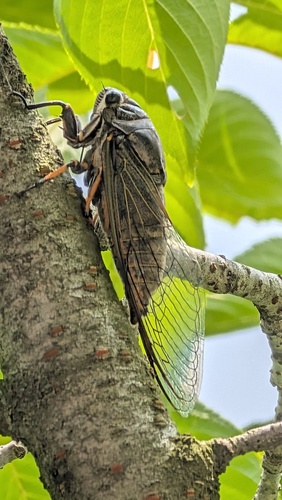
The large black cicada is a common, widespread large cicada in China. Adults are glossy black or blackish-brown, and the male’s abdominal sound apparatus produces a loud, continuous call. Nymphs live in the soil for years sucking sap from plant roots, then emerge, climb nearby trees or weeds, and molt into adults.
Key figures
- Length
- Mean of about 39.9 mm in 7 measured Beijing specimens
- Life cycle
- Nymphs generally live in the soil for 3–5 years or longer; adults begin mating and egg-laying about 20 days after emerging
- Habitat
- Nymphs live in soil near host-tree roots; adults are active on trees; most common where soil is loose and trees are plentiful
- Diet
- Nymphs suck sap from plant roots; adults feed on tree sap with piercing-sucking mouthparts
- Call
- Produced by the male’s abdominal sound apparatus; a single caller indoors measured about 79–82 dB at 2 m
- Emergence
- The final (5th-instar) nymph leaves the soil, climbs nearby trees or weeds, and molts into an adult on branches, leaves, or bark
Life cycle
Egg (overwinters in twigs) → Nymph (in soil, usually 3–5 years or longer) → Adult
Ecological role
Nymphs spend years in the soil sucking plant-root sap. Females cut egg chambers into twigs, and the twig beyond the egg site often wilts and dies. Nymphs can be parasitized by fungi such as Cordyceps cicadae (the “cicada flower”); the shed skin left at emergence is a traditional East Asian crude drug, and nymphs are eaten in China.
Did you know
North American periodical cicadas surface only every 13 or 17 years. This species lays eggs every July and August; in Jinhua it overwinters as twig eggs and soil nymphs of all instars.
Range
Widespread in eastern and central China; also recorded from the Korean Peninsula, northern Southeast Asia, and elsewhere
Status
Common; egg-laying can kill twigs, and it is regarded as a forest and orchard pest, with local outbreaks recorded
Anatomy
- Tymbal — Under a cover on each side of the abdomen lies a ribbed tymbal; tymbal muscles drive the two sides to vibrate alternately
- Wings — The membranes of both the forewings and hindwings are transparent
- Compound eyes — Three simple eyes (ocelli), arranged in a triangle, sit between the large, bulging compound eyes
- Rostrum — Formed from the fused labium, it sheathes the mandibular and maxillary stylets used to pierce and suck sap
- Head — Its front margin is broad, with a depression in the middle
- Abdomen — A flattened oval air chamber inside acts as a resonator, improving the call’s tone and raising its output power
Open the interactive 3D specimen