Lesser Emperor Dragonfly
Anax parthenope
An amphibious hunter of the skies
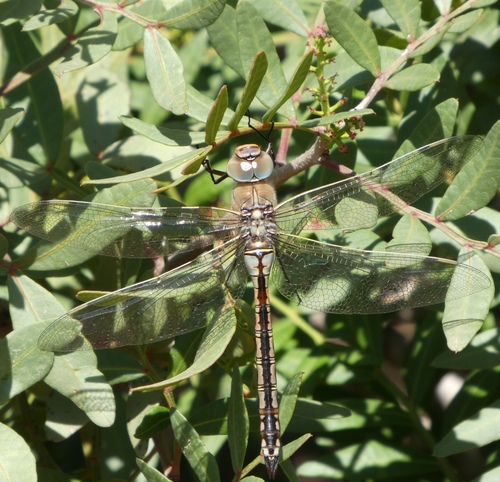
This East Asian form of the lesser emperor is a large, common pond dragonfly, about 70 mm long, with a green thorax and olive-to-brown abdomen. Larvae grow in lowland ponds; emergence peaks in midsummer. Immature adults forage in flight over open ground; mature males visit ponds to find females.
Key figures
- Length
- About 70–80 mm (encyclopedias differ); hindwing about 50–55 mm
- Life cycle
- Larvae develop in lowland ponds; in Japan, adults emerge from about May to September, most in midsummer
- Habitat
- Lowland ponds and their surroundings, also rice paddies; larvae live in ponds rich in water plants
- Diet
- By day, immature adults often forage in flight about 1–2 m above open ground
- Flight
- A swift flier that also migrates across seas in groups
- Vision
- Adult dragonflies and damselflies have compound eyes of up to about thirty thousand facets and can see polarized-light patterns invisible to humans
Life cycle
Egg → Nymph (naiad, living in ponds) → Adult
Ecological role
In Japan its larvae were once common in lowland ponds but have declined in recent years due to water pollution. Studies of odonates suggest that foraging also carries a risk of being caught by predators.
Did you know
Around Tokyo, children catching dragonflies once sought it out, calling males "Gin" (silver) and females "Chan". Natural hybrids with a close relative are also known in the wild.
Range
Lowland ponds in Japan (rare in Hokkaido), the Korean Peninsula, mainland China and Taiwan; from India west to Europe the nominate subspecies occurs instead
Status
Common
Anatomy
- Forewing — Clear with a slight brown tint; in mature females the wings can turn deep brown
- Hindwing — Hindwing about 50–55 mm long
- Compound eyes — Some facets are sensitive to polarized light, which dragonflies and damselflies use to find water from its reflections
- Abdomen — In males the top of abdominal segment 2 is blue and the side of segment 3 silvery; females have a mainly brown abdomen
- Thorax — Green with no markings; the related A. nigrofasciatus has two black stripes on the thorax sides, which tells them apart
- Legs — All three pairs of legs attach to the underside of the thorax
Open the interactive 3D specimen