Chinese Mantis
Tenodera sinensis
An ambush blade disguised as a green leaf
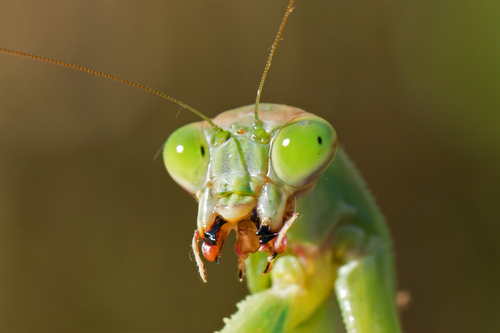
The Chinese mantis is a large green or brown mantis with grasping forelegs, often folded against its thorax as it waits for prey. It eats varied small animals, not just pests. Introduced populations are established in the eastern US, where hummingbird captures have been recorded.
Key figures
- Length
- Females can reach 90–105 mm, among the largest of the mantises native to China
- Life cycle
- The NC State profile describes eggs overwintering in oothecae and nymphs hatching in spring
- Habitat
- Shrubland, grassland, and field margins — vegetation dense enough to ambush prey
- Diet
- Preys on grasshoppers, moths and other insects, as well as spiders; bird captures are also recorded
- Strike
- The forelegs are adapted to grasp prey that comes within reach
- Head turn
- Can rotate its head nearly 180 degrees, making it one of the few insects able to “look back over its shoulder”
Life cycle
Egg (overwinters in an ootheca) → Nymph → Adult
Ecological role
Its prey includes insects and other small animals, not just crop pests. Records also document hummingbird captures; feeding on pests alone does not establish that releasing this mantis has only ecological benefits.
Did you know
Photographs in a bird-predation study identify Chinese mantises capturing hummingbirds. These records establish that it happens, but do not reveal what share of the mantis’s everyday diet is birds.
Range
Native to China and East Asia; widely naturalized in North America after its introduction in the late 19th century
Status
Introduced populations are established in the eastern US; this does not establish global conservation status
Anatomy
- Grasping foreleg (raptorial foreleg) — Rows of spines on the inner edge help the closing forelegs grasp prey; capture is not guaranteed
- Head — Can rotate nearly 180 degrees, letting it look all around with barely any need to move its body
- Compound eyes — The dark false pupil inside each eye appears to “follow” the viewer, but this is only an optical illusion
- Wings — In males, the wings extend past the abdomen, aiding flight during courtship; females’ wings are relatively shorter
- Abdomen — Contains the ovaries and visibly swells and thickens before egg-laying
- Prothorax — The slender front section of the thorax; observe how the forelegs fold against the chest
Open the interactive 3D specimen