Japanese Carpenter Ant
Camponotus japonicus
A soil nester with big and small workers
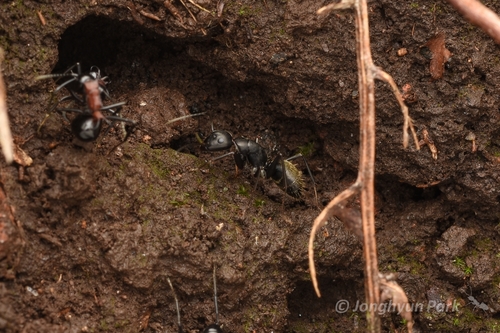
The Japanese carpenter ant is a fairly large ant widespread in East Asia. Minor workers forage and tend brood, while majors mainly guard the nest. Workers recognize nestmates by antennal sensing of cuticular hydrocarbons; nests lie in open-ground soil with entrances at the surface.
Key figures
- Length
- Workers about 7–12 mm (with major and minor subcastes)
- Color
- Workers are usually black, but maroon-headed workers are more common in colder, higher-latitude northern China
- Nuptial flight
- In Japan, winged reproductives fly out on nuptial flights in May and June
- Habitat
- Nests in soil in open habitats; entrances open directly onto the surface without a surrounding mound
- Diet
- Tends aphids and feeds on the sugar-rich honeydew they excrete
- Cooperation
- Recognizes nestmates by sensing cuticular hydrocarbons with its antennae, and acts aggressively toward ants from other colonies
Life cycle
Egg → Larva → Pupa → Adult (worker/queen/male)
Ecological role
Workers attack ants from other colonies, which researchers take as a sign that neighboring nests keep distinct foraging ranges. Ants as a group are often described as soil architects, seed dispersers, and predators. Some ants tend sap-feeding insects such as aphids, feeding on the sugar-rich honeydew they excrete and helping defend them from enemies; researchers list this species among honeydew-feeding ants. Widespread and fairly large, this species is used to study how environment affects ant body traits and how ants recognize nestmates.
Did you know
A founding queen raises her first workers on limited resources: for the same investment, the more workers she makes, the smaller they are.
Range
Japan, mainland China, and the Korean Peninsula
Status
Common
Anatomy
- Jaws (mandibles) — Major workers differ clearly from minors in head width and mandible length, and mainly serve as nest defenders
- Waist (petiole) — A slender, waist-like structure connecting the thorax and abdomen
- Rear abdomen (gaster) — The rounded rear section of the body, just behind the waist
- Antennae — Each antenna carries about 180 basiconic sensilla that detect cuticular hydrocarbons, used to recognize nestmates
- Compound eyes — Set on either side of the head; the head is usually black and dull rather than shiny
- Legs — Slender legs extending from the thorax
Open the interactive 3D specimen