Western Honey Bee
Apis mellifera
The architect who draws maps in dance
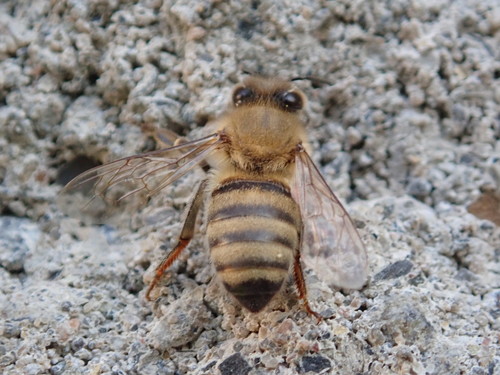
The western honey bee lives in colonies with queens, workers and drones, communicating through pheromones and dance. Workers rear brood, build comb and forage; lifespan varies with season. In cold climates, colonies survive winter by clustering for warmth and consuming stored food.
Key figures
- Length
- Workers about 12–13 mm; queens can reach 18–20 mm
- Weight
- Workers weigh about 90 mg; over its lifetime one worker produces less than 1 g of honey
- Lifespan
- Summer workers live about 5–6 weeks; overwintering workers can survive several months
- Habitat
- Nests in tree hollows or managed hives; cold-climate colonies cluster and generate heat in winter
- Diet
- Feeds on nectar and pollen; nectar is converted into honey as winter food stores
- Communication
- On vertical comb, waggle run direction and duration encode a food source’s bearing and distance
Life cycle
Egg → Larva → Pupa → Adult (worker/queen/drone)
Ecological role
As one of the world’s most important commercial pollinators, it pollinates large numbers of food and cash crops; colony health is also regarded as a sensitive indicator of pesticide pollution and ecological stress.
Did you know
On vertical comb, a waggle run’s angle from upward encodes food direction relative to the sun. Run duration relates to distance; the duration of the whole dance is not the distance code.
Range
Native to Europe, Africa, and the Middle East; now spread through beekeeping to every continent except Antarctica
Status
Widely kept in managed hives, but wild populations are threatened by pesticides, parasitic mites, and habitat loss
Anatomy
- Stinger — A worker’s stinger has barbs; if it detaches after entering tough skin, damage to her abdomen can be fatal
- Pollen basket (corbicula) — A concave structure on the hind leg’s tibia used to carry compacted pollen loads back to the hive
- Wings — Forewings and hindwings link together via a row of tiny hooks (hamuli) into a single surface, beating about 230 times per second
- Compound eyes — Can detect ultraviolet light, revealing nectar guide patterns on flowers that are invisible to the human eye
- Antennae — Sense scent and vibration, serving as the colony’s main organ for exchanging pheromone signals
- Thorax — Bears two pairs of wings and three pairs of legs; its flight muscles generate heat that also helps keep the hive warm
Open the interactive 3D specimen