Migratory Locust
Locusta migratoria
A life shaped by crowding
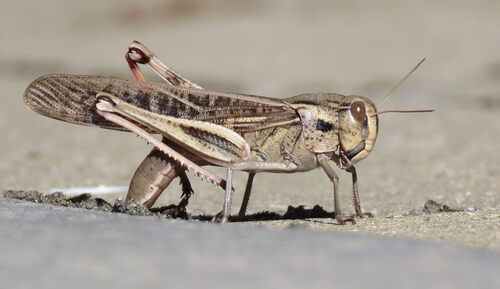
Population density shapes the Oriental Migratory Locust’s way of life. Gregarious nymphs form marching bands and adults form flying swarms. Experiments on migratory locust nymphs link neurotransmitters to this shift, with mechanisms differing between locust species.
Key figures
- Body length
- Asian migratory locusts: males 35–50 mm, females 45–55 mm
- Generations
- In the fields, 1 generation per year at Chengde and Tumotezuoqi, 2 at Wen’an
- Habitat
- Asian migratory locusts mainly live among reeds and sedges beside rivers and lakes
- Diet
- Asian migratory locusts favor grasses and can damage many crops during outbreaks
- Development
- Oriental Migratory Locust nymphs pass through 5 instars before adulthood
- Phase change
- Changing population density can shift behavior between solitary and gregarious phases
Life cycle
Egg → Nymph (5 instars) → Adult
Ecological role
Migratory locusts eat plants, and gregarious nymphs and adults can damage crops. Asian migratory locusts favor grasses such as reeds; alternating floods and dry periods change food supplies and egg-laying sites.
Did you know
In migratory locust experiments, serotonin injected into the brains of isolated gregarious nymphs accelerated solitary behavior, unlike its gregarizing role in desert locust studies.
Range
The Oriental subspecies occurs in China; the migratory locust as a species ranges across much of Europe, Africa, Asia and Oceania
Status
An important agricultural pest in China, with generation number varying by regional climate
Anatomy
- Hind legs — The thick hindlegs extend from the rear of the thorax
- Wings — The narrow wings extend backward along the body
- Hearing organ (tympanum) — A membrane area on either side of the front of the abdomen
- Compound eyes — Large eyes project from either side of the head
- Antennae — Slender antennae extend forward from the head
- Thorax shield (pronotum) — A plate behind the head covers the upper surface of the thorax
Open the interactive 3D specimen