Oriental Mole Cricket
Gryllotalpa orientalis
A tunneling engineer deep underground
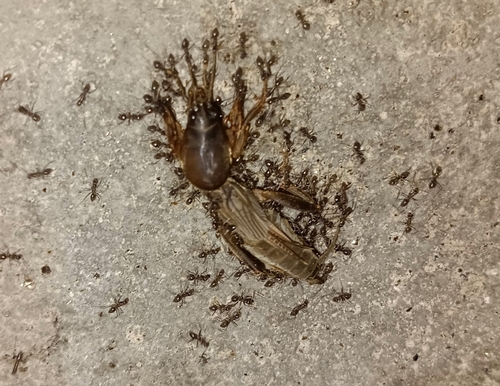
The Oriental Mole Cricket has a cylindrical, hairy body and broad digging forelegs. It eats seedling roots and stems as well as soil insects and earthworms. Shallow horizontal and deeper vertical burrows serve feeding, refuge and breeding, and are modified as needs change.
Key figures
- Body length
- In Japan, about 30 mm long, with a cylindrical body covered in fine hairs
- Generations
- In western Japanese wetlands, one generation per year, overwintering as nymphs or adults
- Habitat
- Burrows in soil in wetlands and farmland
- Diet
- Eats seedling roots and stems, as well as soil insects and earthworms
- Digging
- Broad, flattened forelegs dig soil and can also scrape or tap the substrate
- Wing forms
- In western Japanese wetlands, long-winged and short-winged forms alternate with the seasons
Life cycle
Egg → Nymph (multiple molts, burrow-dwelling) → Adult
Ecological role
The Oriental Mole Cricket is a subterranean crop pest that eats seedling roots and stems, but also soil insects and earthworms. It uses different burrows for feeding and refuge, modifying tunnels or moving sites as its needs change.
Did you know
In western Japanese wetlands, nymphs can overwinter and become long-winged adults, while short-winged adults overwinter as adults. Both forms have an annual cycle and alternate with the seasons.
Range
China, Japan, the Korean Peninsula and Taiwan, among other areas
Status
A subterranean agricultural pest that feeds on seedling roots and stems
Anatomy
- Front Legs — The broad, flattened fore femora and tibiae are suited to digging
- Pronotum — The enlarged pronotum lies behind the head
- Hindwing — The hindwings extend backward from the thorax along the back
- Abdomen — A pair of slender cerci projects from the end of the cylindrical abdomen
- Compound Eyes — Small eyes are visible on either side of the head
- Antennae — A pair of slender antennae extends from the head
Open the interactive 3D specimen