Common Mormon
Papilio polytes
Painting a poisonous butterfly’s pattern onto its own wings
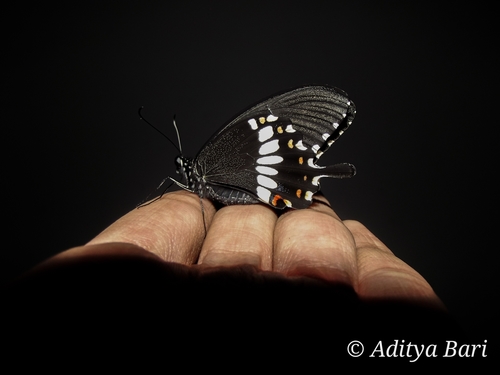
Male Common Mormons have black wings with conspicuous white markings. Females vary: some resemble males, others mimic unpalatable swallowtails. This Batesian mimicry can reduce predation and is linked to a region containing the doublesex gene.
Key figures
- Wingspan
- About 70–115 mm; males are generally smaller than females
- Development
- The host plants larvae eat affect their growth and survival
- Habitat
- Tropical and subtropical forests, farmland, suburban gardens and cities
- Diet
- Larvae eat rue-family hosts such as citrus; adults drink nectar
- Mimicry
- Some females mimic unpalatable swallowtails such as Pachliopta aristolochiae
- Puddling
- Males drink salty, mineral-bearing fluids from moist ground and watersides
Life cycle
Egg → Larva (five instars) → Pupa → Adult
Ecological role
Larvae can damage host plants such as citrus, while adults visit flowers for nectar. Females’ resemblance to unpalatable swallowtails is Batesian mimicry; mimetic forms and their models differ across regions.
Did you know
Males obtain salts and minerals by puddling, then transfer them to females in spermatophores during mating. These materials can reach the eggs and aid reproduction.
Range
Asia from Pakistan and India eastward, including southern coastal China, Malaysia, Indonesia, the Philippines and southwestern Japanese islands
Status
Occurs in farmland, gardens and cities; larvae can damage host plants
Anatomy
- Forewing — The black forewings bear white markings
- Hindwing — Males have a row of white spots across the black hindwings
- Tail — Slender extensions project from the hindwing edges
- Antennae — Antennae with swollen tips extend from the head
- Compound Eyes — Large, rounded eyes sit on either side of the head
- Abdomen — The visibly segmented body region behind the thorax
Open the interactive 3D specimen