Seven-spot Ladybird
Coccinella septempunctata
An aphid hunter in warning red
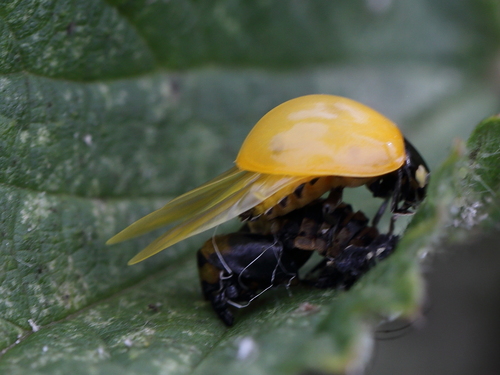
The seven-spot ladybird has black spots on red or orange-red wing cases. Larvae and adults prey on aphids and other small insects and their eggs. Warning coloration accompanies chemical defence: when stimulated, it can release alkaloid-rich hemolymph from its leg joints.
Key figures
- Length
- Adults about 7–8 mm in Cornell’s profile, with a domed body
- Generations
- 1–2 per year in the northeastern US; adults overwinter in sheltered sites
- Habitat
- Farmland, grassland, and forest edges, most common wherever aphids are dense
- Diet
- Mainly aphids, with other small insects and their eggs also taken as prey
- Predatory stages
- Larvae as well as adults prey on aphids and contribute to pest suppression
- Defense
- When stimulated, it can release alkaloid-rich defensive fluid from its leg joints
Life cycle
Egg → Larva (four instars) → Pupa → Adult
Ecological role
Its predation helps suppress some aphid populations. Introduced to North America for biological control, it may also displace native lady beetles in some areas; pest suppression does not make every effect of an introduction beneficial.
Did you know
The larva is no miniature adult: it is elongated and dark, with prominent legs. It passes through four instars before pupating and becoming a domed adult.
Range
Native range includes Eurasia; introduced populations are established in North America
Status
A common introduced species in parts of North America
Anatomy
- Hardened forewings (elytra) — Hard forewings patterned with black spots on red; the bright coloring is a warning signal to predators
- Spots — Usually seven black spots; consider body shape and the pronotum alongside the spot pattern
- Head — A pale patch on each side of the head can be observed alongside the markings on the wing cases
- Legs — When stimulated, its leg joints can release alkaloid-rich fluid that helps deter predators
- Antennae — Short antennae with enlarged, club-shaped tips are a visible feature of the head
- Pronotum — The dark pronotum has pale markings at its front corners that can aid identification
Open the interactive 3D specimen