Japanese Rhinoceros Beetle
Trypoxylus dichotomus
A gladiator raised in leaf litter
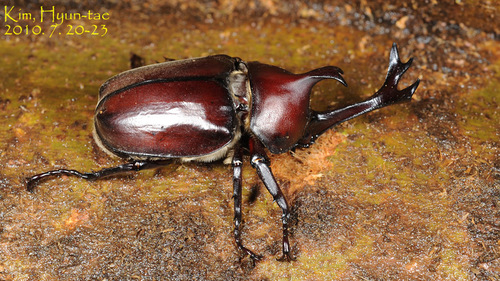
The Japanese rhinoceros beetle is a large East Asian scarab. Males have a head horn and a shorter thoracic horn, used in fights at sap sites. Adults are mainly active at night and feed on tree sap; larvae develop in leaf mould.
Key figures
- Length
- Japanese subspecies: about 30–55 mm, excluding the horn
- Combat
- Males use the head horn to lift rivals away from feeding sites
- Life cycle
- In Japan, one generation per year; larvae overwinter and become adults the next summer
- Habitat
- Woodlands and satoyama landscapes; larvae live in leaf mould
- Diet
- Larvae feed on leaf mould, decaying wood and other organic matter; adults lap up tree sap
- Flight
- During flight, the beetle extends its elytra and membranous hindwings
Life cycle
Egg → Larva (overwinters in Japan) → Pupa → Adult
Ecological role
Adults feed at sap sites, where males compete for access. Larvae eat decaying plant material and contribute to the breakdown of forest litter.
Did you know
A fight over food can also affect reproduction: females visit sap sites to feed, giving the males that hold these sites opportunities to mate.
Range
China, the Korean Peninsula, Japan, Taiwan, and parts of Indochina, including Vietnam
Status
Commonly kept and bred in captivity in Japan
Anatomy
- Head horn (cephalic horn) — A long forked horn projecting from the male’s head, used in fights to hook under and flip over a rival
- Thoracic horn — A short horn on the front thorax shield (pronotum) that grips against the head horn like a pincer for leverage
- Elytra — The hardened forewings are modified into elytra that lift during flight to expose the membranous hindwings beneath
- Compound eye — Made up of many individual facets, sensitive to moving light and shadow, and drawn to light at night
- Fan-shaped antennae (lamellate antennae) — The tips are flattened into thin plates that open and close, expanding the surface for catching scent molecules when spread
- Foreleg — Tipped with stout claws used to grip bark and to flip over rivals
Open the interactive 3D specimen