Chinese Stag Beetle
Dorcus hopei
A forest beetle with sword-like jaws
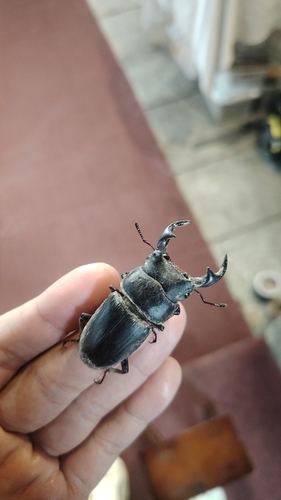
Male Chinese Stag Beetles have sword-like jaws with conspicuous projections and small inner teeth, and different jaw and body forms. In the Japanese subspecies, adults visit sap at night while larvae inhabit white-rotted wood, occupying different places as they grow.
Key figures
- Body length
- Japanese subspecies: males 30–75 mm, females 30–45 mm, including mandibles
- Captive lifespan
- In captivity in Korea, adults have lived for more than 35 months
- Habitat
- Larvae of the Japanese subspecies inhabit white-rotted parts of fallen or standing dead trees
- Feeding
- Adults of the Japanese subspecies often visit tree sap at night
- Territory
- Large males of the Japanese subspecies often occupy favorable sap-feeding sites
- Jaw forms
- Males have three forms differing in jaw shape and body size
Life cycle
Egg → Larva → Pupa → Adult
Ecological role
Stag beetle larvae generally feed on decaying wood and participate in forest nutrient cycles. Japanese-subspecies larvae occupy white-rotted fallen and standing dead trees; habitat development and overcollection threaten these environments locally.
Did you know
Experiments on another stag beetle, Cyclommatus metallifer, link larval food conditions to adult male jaws; applying a juvenile-hormone analogue in the prepupal stage also enhanced jaw growth.
Range
Central and northeastern China, Korea; the Japanese subspecies occurs from southern Hokkaido to Kyushu
Status
Bred in captivity; habitat development and overcollection have threatened the Japanese subspecies
Anatomy
- Mandibles — The sword-like mandibles bear a prominent projection and a smaller inner tooth
- Elytra — Small males and females of the Japanese subspecies have distinct rows of elytral punctures
- Head — The broad, flat head bears a pair of projecting mandibles
- Antennae — Antennae extend from the sides of the head, ending in flattened segments
- Legs — The legs extend from the thorax and end in curved claws
- Pronotum — The broad pronotum lies directly behind the head
Open the interactive 3D specimen