Citrus Longhorned Beetle
Anoplophora chinensis
A long-whiskered guest that turns tree trunks into cradles
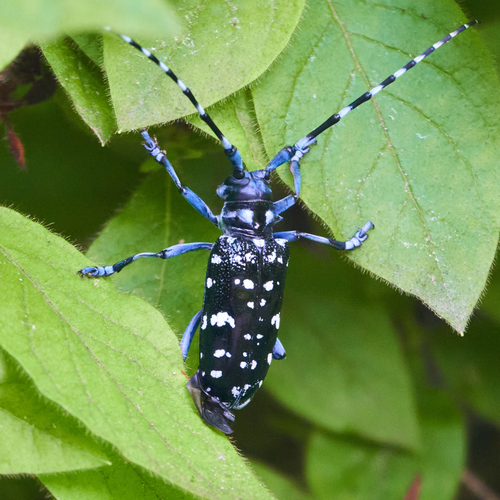
A black longhorn beetle with white-spotted wing covers; male antennae reach about 1.7–2 times body length. It attacks many woody hosts and is a key citrus pest in Asia. Females chew T-shaped bark slits near the trunk base for eggs; larvae bore into the lower trunk and roots, usually maturing in 1 year, sometimes 2.
Key figures
- Length
- About 19–37 mm; male antennae about 1.7–2 times body length
- Life cycle
- Usually completes a generation in 1 year, sometimes 2; most overwinter as larvae
- Habitat
- Citrus and other orchards in Asia; mostly urban trees where introduced. Larvae live in the lower trunk and roots of living trees
- Diet
- Polyphagous on many woody plants; larvae feed in the cambium and then the wood, adults on leaves, twigs and bark
- Damage
- Larvae tunnel galleries inside the trunk, which can weaken the tree or kill it outright
- Senses
- Per a 2010 review, mate-finding relies on contact and short-range pheromones
Life cycle
Egg (laid singly in a bark slit) → Larva (bores into the lower trunk and roots; most overwinter at this stage) → Pupa (in a chamber at the tunnel end) → Adult
Ecological role
The beetle has a very wide host range. Larvae feed under the bark first, then bore into wood at the trunk base and roots. Repeated attack over years disrupts the vascular tissue and weakens the tree, which can kill it. In Asia the greatest losses are in fruit orchards, especially citrus; it is an EU quarantine pest and on the EPPO A2 list.
Did you know
Mostly moved in bonsai and nursery stock. First found in Lombardy, Italy, in 2000; now local in Italy and Türkiye, with French, Dutch and other outbreaks eradicated.
Range
Native to Asia, mainly China, Japan and the Korean Peninsula, with records from Vietnam, the Philippines and elsewhere; locally present in Italy and Türkiye, with few occurrences in Croatia; US outbreaks were eradicated
Status
On the EPPO A2 list and an EU quarantine pest; widespread in China and Japan, and under eradication or containment where found in Europe
Anatomy
- Antennae — Made of 11 segments, each white or pale blue at the base and black at the tip; about 1.7–2 times body length in males, 1.2 times in females
- Elytra — Glossy black with white patches; 20–40 small tubercles near the base give a grainy surface that separates it from the Asian longhorned beetle
- Mandibles — Adults gnaw twigs and bark with them during maturation feeding; females also chew T-shaped slits in bark to lay eggs
- Compound Eyes — A pair of compound eyes on either side of the head, near the antenna bases
- Pronotum — Bears a prominent pointed process on each side; may show bluish-white hair spots on either side or be entirely black
- Legs — Three pairs of legs that carry the adult along trunks and twigs
Open the interactive 3D specimen