Chinese Tiger Beetle
Cicindela chinensis
Pursuit on paths, ambush at burrows
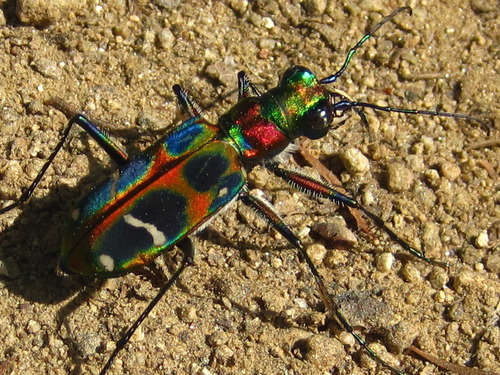
Chinese Tiger Beetles prey on small animals as adults and larvae, but hunt in different ways. In related Japanese beetles, adults search the ground for food, while larvae wait at self-dug burrows, seize passing prey and pull it inside.
Key figures
- Body length
- Related Japanese beetles are about 20 mm long
- Life history
- In Korea, adults are active in spring and autumn and overwinter as adults
- Habitat
- In Korea, it lives along mountain paths
- Diet
- In related Japanese beetles, adults eat ants, earthworms and caterpillars; larvae ambush small animals passing their burrows
- Visual pursuit
- In other tiger beetles, motion blur during a chase can lead to stop-and-go pursuit
- Burrow life
- Larvae of related Japanese beetles grow in burrows and enlarge the entrances after molting
Life cycle
Egg → Larva (burrowing, three instars) → Pupa → Adult
Ecological role
Tiger beetles can help people track habitat change, though life histories and rearing needs vary by species. Related Japanese beetles eat many kinds of small animals; larvae depend on prey passing their burrows.
Did you know
Experiments on another tiger beetle found that motion blur reduces prey contrast; high-contrast targets or lower angular velocities can allow continuous pursuit.
Range
Widespread in the Far East, including the Korean Peninsula; a closely related Japanese beetle occurs on Honshu, Shikoku, Kyushu, Tsushima and Yakushima
Status
Tiger beetles can serve as indicators of habitat change
Anatomy
- Mandibles — A pair of curved, crossing mandibles projects from the head
- Elytra — A pair of long elytra lies on the back behind the pronotum
- Compound Eyes — Large eyes project from either side of the head
- Legs — Long, slender legs extend from the thorax
- Antennae — Slender antennae extend from the front of the head
- Pronotum — The pronotum lies between the head and elytra
Open the interactive 3D specimen